The RNA Revolution That Almost Wasn’t
Remember when CRISPR-Cas9 was going to cure everything? Those heady days of 2015 when every science conference buzzed with talk of precision DNA editing, when venture capital poured into gene therapy startups, when we genuinely thought we’d have designer babies and cured genetic diseases by now. Well, Cas9 didn’t disappear exactly, but it certainly didn’t live up to the hype either.
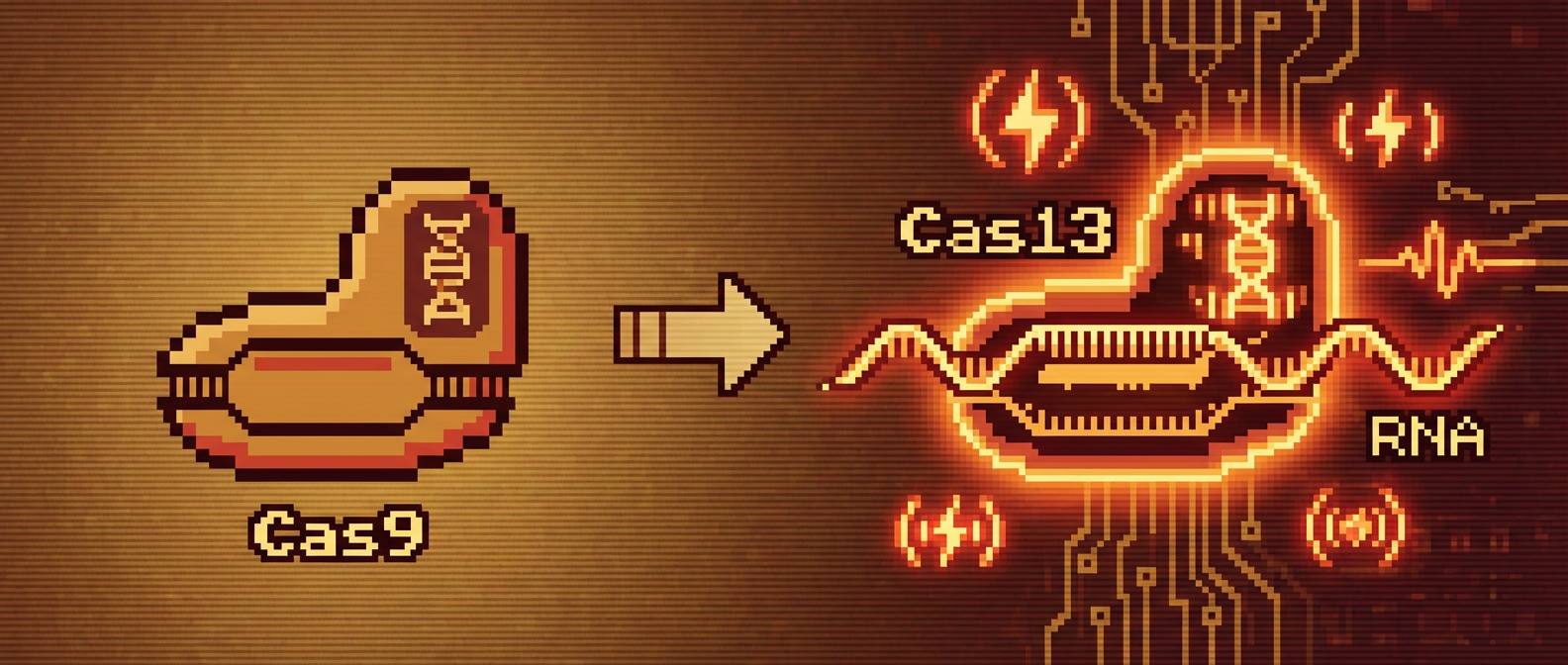
The problem was never the science itself. Cas9 works beautifully at what it does: cutting specific sequences in DNA with remarkable precision. But cutting DNA is permanent, irreversible, and frankly, terrifying when you’re talking about human therapeutic applications. Sure, we’ve seen some impressive successes in treating sickle cell disease and certain cancers, but the clinical pipeline moved at a glacial pace. Every edit had to be perfect because there was no going back.
Enter CRISPR-Cas13, the RNA-targeting cousin that seemed almost quaint by comparison. While Cas9 grabbed headlines, Cas13 quietly solved the reversibility problem that had been haunting the field. Instead of permanently altering the genome, Cas13 targets RNA molecules, the temporary messengers that carry genetic instructions from DNA to protein-making machinery. This difference matters more than most people initially realized.

The Huntington’s Breakthrough That Changed Everything
The moment everything clicked was January 2025, when the Broad Institute Huntington’s trial results dropped. A 73% reduction in huntingtin protein levels with zero detectable off-target effects. Zero. In a disease where the toxic protein accumulation slowly destroys brain cells, this wasn’t just promising data. It was game-changing.
But here’s what made the result truly elegant: the therapy was reversible. If something went wrong, if patients experienced unexpected side effects, the treatment would naturally fade as the targeting RNA degraded. Compare this to Cas9’s permanent DNA edits, where a mistake could last a lifetime. Suddenly, the risk-benefit calculation for genetic therapies shifted dramatically.
The Huntington’s trial succeeded because Cas13 could target the mutant RNA transcripts while leaving the normal copies relatively intact. This selectivity comes from RNA’s secondary structure, the way it folds and forms loops and hairpins. These structural features provide targeting opportunities that simply don’t exist in the more rigid double helix of DNA.
The Coverage Problem That Cas9 Never Solved
The real revelation came six months later when researchers published their comprehensive analysis in Nature Medicine Cas13 coverage study. The numbers were staggering: Cas13 systems could theoretically target 89% of known disease-causing RNA sequences, compared to Cas9’s 23% coverage of equivalent DNA targets.
This disparity exists because RNA offers more flexibility in targeting. DNA editing requires finding a specific sequence next to what’s called a PAM site, a short DNA sequence that Cas9 recognizes. These PAM sites are scattered throughout the genome, but they’re not everywhere you need them. It’s like having a highly precise surgical instrument but only being able to operate where the streetlights happen to be positioned.
RNA targeting doesn’t have this limitation. Every RNA molecule that gets transcribed becomes a potential target, and those secondary structures I mentioned earlier provide additional specificity. The result is a therapeutic platform that can address a much broader range of genetic diseases, from common conditions to ultra-rare disorders that affect only hundreds of patients worldwide.
From Lab Bench to Market Reality
The financial markets caught on faster than many scientists expected. Prime Medicine’s stock surge of 340% in January 2026 following FDA fast-track approval wasn’t just speculative enthusiasm. It reflected a fundamental shift in how investors viewed the timeline from discovery to clinical application for RNA-targeted therapies.
The regulatory pathway for Cas13 therapies proved smoother partly because of their reversible nature. When regulators evaluate risk, permanent genetic changes naturally trigger more extensive safety requirements than temporary RNA interference. The precedent set by RNA interference drugs like Onpasemnogene and antisense oligonucleotides provided a regulatory framework that Cas13 therapies could adapt rather than build from scratch.
But perhaps the most significant development came from an unexpected direction. Jennifer Doudna’s team at UC Berkeley cracked the delivery problem that had been limiting all CRISPR applications. Their February 2026 report on successful brain delivery using engineered exosomes represented years of work on the unglamorous but critical challenge of getting molecular tools to their intended targets.
What This Means for the Next Decade
The convergence of improved targeting, better delivery, and regulatory acceptance is creating opportunities that extend far beyond treating genetic diseases. Cas13’s ability to modulate RNA levels opens possibilities for addressing complex disorders where protein levels, rather than gene function itself, drive pathology.
Consider neurodegenerative diseases, where protein aggregation creates a toxic cascade. Traditional drug development focuses on small molecules that might slow this process. Cas13 approaches the problem upstream, reducing the production of problematic proteins before they can misfold and aggregate. It’s a fundamentally different therapeutic strategy.
The near-term applications will likely focus on diseases with clear genetic components and well-understood pathways. But the longer-term possibilities reach into areas like aging research, where modulating specific RNA networks might influence cellular senescence, or cancer therapy, where temporarily silencing oncogenes could complement existing treatments without the permanence concerns that limit current genetic approaches.
The real test won’t be whether individual Cas13 therapies succeed in clinical trials. The technology has already demonstrated that potential. The question is whether the field can scale these approaches across the thousands of genetic conditions that might benefit from RNA-level intervention, and whether we can do so while maintaining the safety profile that made Cas13 attractive in the first place. That’s the conversation I’m most curious to have as these trials expand beyond proof-of-concept studies.